Call today for a free quote
07775 837892
Call today for a free quote
07775 837892
Leylandii conifers are popular for their fast growth, evergreen foliage and ability to provide privacy. However, without regular maintenance, they can quickly become too large for the space available.
ArborLife Tree Surgeons were recently called to a property in Claygate, near Esher in Surrey, where two large Leylandii conifers had become a serious problem for the homeowner.
The trees had grown to an imposing height, casting extensive shade across the garden. More concerningly, they were also pushing against a boundary wall, causing it to lean.
The homeowner wanted both trees removed to address the problem with the wall and allow more natural sunlight into the garden.
This was a job where removing the trees offered a more practical long-term solution than simply reducing their height.
As the before photograph shows, the Leylandii had developed into substantial trees, towering above the garden fence and nearby outbuildings.
Their dense evergreen foliage created a considerable amount of shade.
Unlike deciduous trees, which lose their leaves in autumn, Leylandii retain their foliage throughout the year. This means the shade they create can be persistent, particularly when planted close to smaller gardens.
In this Claygate garden, the trees were preventing sunlight from reaching much of the outdoor space.
Removing them would open up the garden, allowing more daylight to reach the lawn and surrounding planting areas.
The second issue was the pressure being exerted on the boundary wall.
As trees grow, their trunks and root systems can affect nearby structures, particularly where they have been planted too close to walls, fences or paving.
In some situations, expanding roots or the base of a tree can exert pressure on adjacent masonry, causing movement or displacement.
For this property, the two large conifers were pushing the wall out of alignment.
Although removing the trees would eliminate further growth from those particular trees, any existing structural damage to the wall would still need to be assessed separately.
This is one reason why choosing the right planting position is so important when introducing fast-growing conifers into a garden.
Removing large conifers from a residential garden requires careful planning, particularly when there are fences, sheds, neighbouring properties and other obstacles nearby.
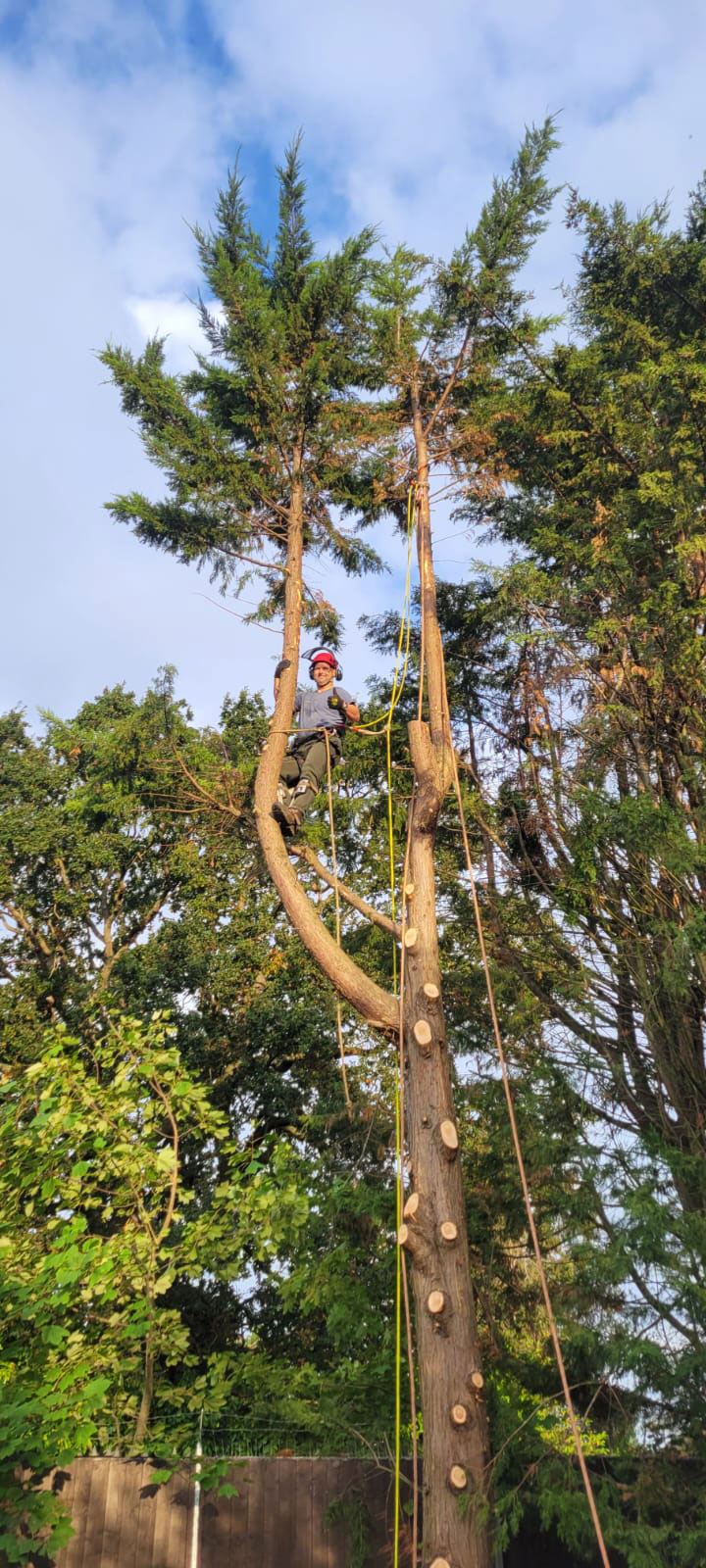
The photographs show ArborLife undertaking the removal using professional climbing and rope-access equipment.
Rather than relying on a single uncontrolled fell, sectional dismantling allows a tree to be taken down progressively, with branches and sections of the trunk removed in a planned sequence.
This approach is particularly useful in confined gardens where there may be insufficient space to fell a large tree in one piece.
The photograph taken during the work shows the conifer with much of its lower branch structure already removed, leaving the upper sections to be dismantled.
The objective was to remove both Leylandii while managing the risks to the surrounding garden and nearby structures.
Homeowners often ask whether an overgrown Leylandii can simply be cut down to a more manageable height.
Sometimes height reduction is possible, particularly where the trees have been regularly maintained.
However, Leylandii generally do not regenerate well from old, bare brown wood. Cutting too far back can leave permanent gaps or unsightly sections of the tree.
Reducing the height also does not necessarily resolve problems caused by the position of the trunk or roots.
Where a conifer has become excessively large, is causing structural concerns or occupies too much of a small garden, complete removal may be the more suitable option.
Removing large, unwanted Leylandii can make a substantial difference to how a garden looks and feels.
More natural sunlight
Removing dense evergreen canopies can allow significantly more daylight to reach lawns, patios and flowerbeds.
More usable garden space
Large conifers can occupy valuable space, both at ground level and through the spread of their branches.
Reduced pressure on nearby structures
Where tree growth is contributing to movement in walls or other structures, removal can eliminate the continuing growth pressure from those trees.
Greater planting opportunities
Once an oversized conifer has been removed, homeowners may have more freedom to introduce smaller trees, shrubs and other planting better suited to the available space.
Less ongoing maintenance
Large Leylandii can require regular trimming to prevent further growth and maintain their shape. Removing unsuitable trees can reduce this recurring maintenance requirement.
ArborLife Tree Surgeons regularly undertakes conifer removal, tree felling and sectional dismantling throughout Surrey.
Our team works in Claygate, Esher, Oxshott, Cobham, Weybridge, Leatherhead, Epsom and surrounding areas.
Whether you have a single oversized conifer, a row of Leylandii blocking sunlight or trees growing too close to a boundary wall, we can assess the situation and recommend appropriate work.
Yes. Where Leylandii have been planted close to a wall, the expanding trunk base or roots may contribute to movement or displacement. However, wall damage can have several causes, so the situation should be assessed before attributing it entirely to the trees.
In many cases, yes. Leylandii have dense evergreen foliage that blocks light throughout the year. Removing large specimens can noticeably improve natural light levels, depending on the garden's orientation and surrounding buildings.
Yes. Professional tree surgeons can often remove large conifers in confined gardens using sectional dismantling techniques. The method depends on access, tree condition and nearby structures.
The cost depends on their height, trunk diameter, access, proximity to buildings and the amount of material requiring removal. A site visit allows a tree surgeon to provide a quotation based on the actual work involved.
If a Leylandii is felled and only the stump remains, it will not normally regrow from that stump. This differs from some broadleaved tree species that can produce new shoots after cutting.
Stump grinding is often recommended where the area will be replanted, landscaped or used for a new garden feature. However, stump removal is not always necessary. The best option depends on what you intend to do with the space.
If overgrown conifers are blocking sunlight, crowding your garden or affecting nearby walls and fences, ArborLife Tree Surgeons can help.
We provide professional Leylandii removal, conifer felling and sectional tree dismantling throughout Claygate, Esher and Surrey.
Contact ArborLife today to arrange an assessment and quotation for removing unwanted conifers from your garden.
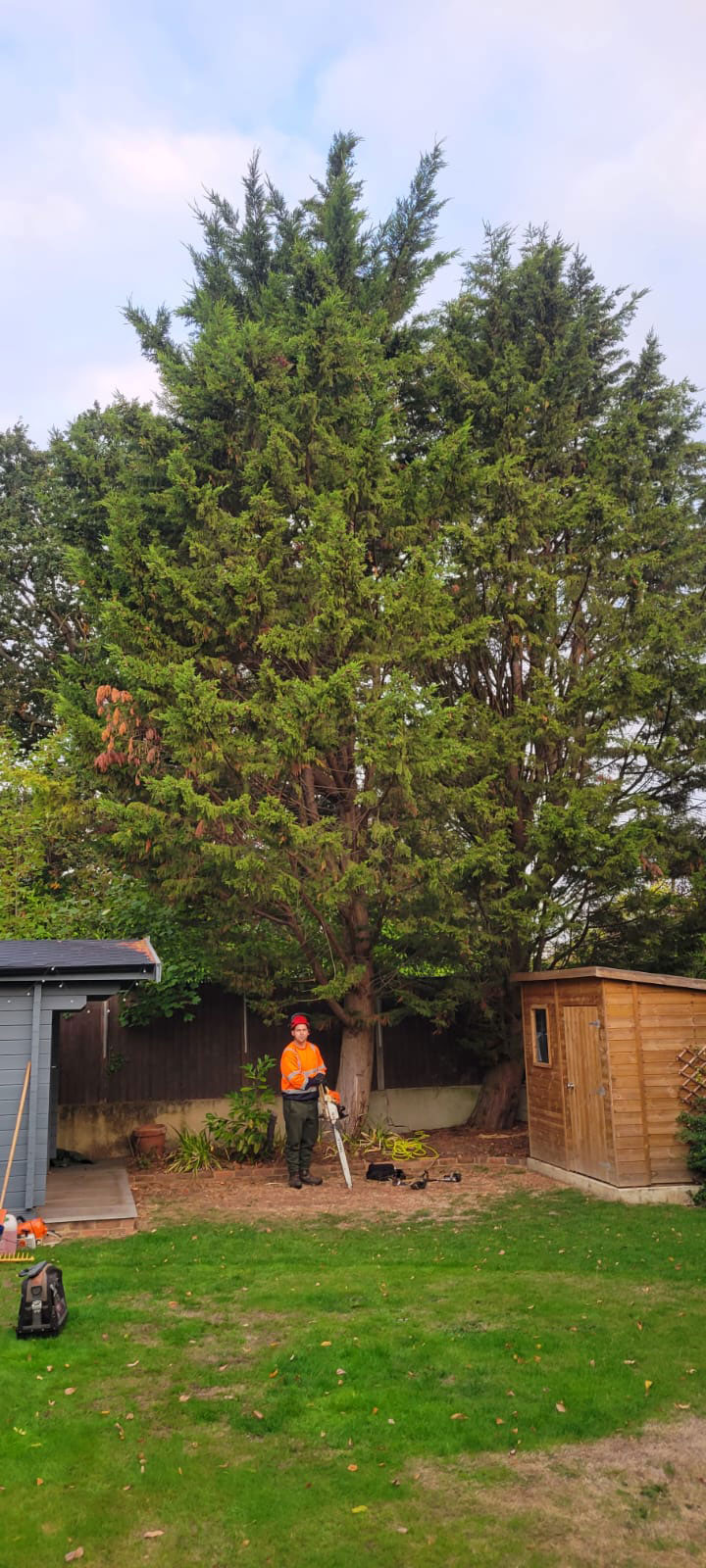
The two mature Leylandii were blocking sunlight and putting pressure on the garden boundary wall.

ArborLife carrying out sectional dismantling of one of the large conifers in a residential garden.


© 2026 Arborlife